
PROCUREMENT INSIGHTS
How to Evaluate an Office Floor Lamp Supplier: 7 Questions Buyers Should Ask
A practical evidence checklist for comparing an office lighting supplier before sample approval and production.
THE SHORT ANSWER
Evaluate an office floor lamp supplier against seven checks: product fit, performance evidence, market documentation, sample-to-production quality, version control, delivery capability, and communication and after-sales support. For each answer, request a record that applies to the exact configuration you intend to buy.
A supplier shortlist should begin with evidence you can check. The aim is to connect the proposed luminaire, the supporting documents and the order you will actually receive.
For distributors, lighting brands and project buyers, the first comparison is often a catalogue and a quotation. Those are useful starting points. A stronger evaluation asks what sits behind them: which configuration is being offered, what has been tested, how changes are controlled and what has been agreed for delivery and service.
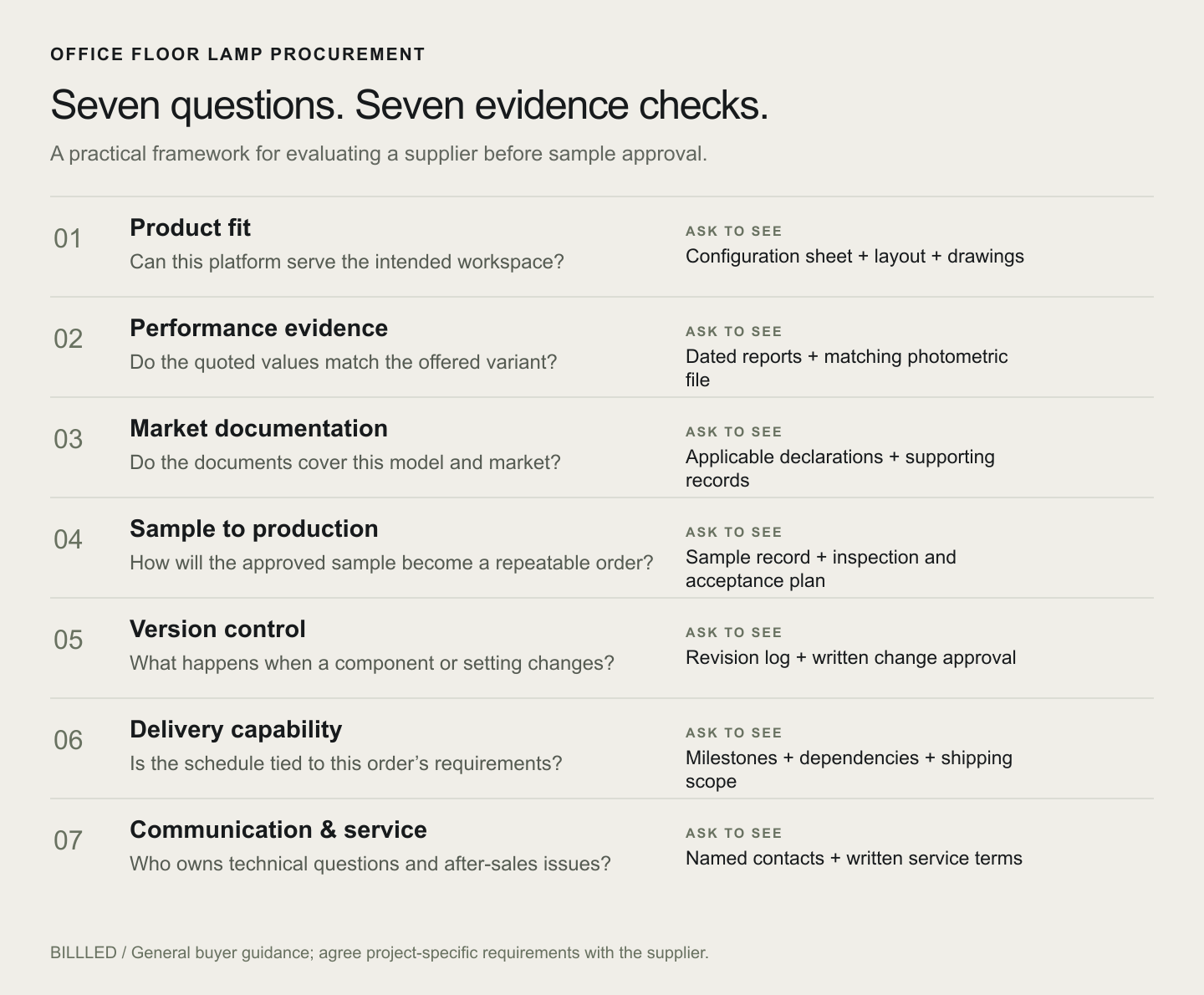
Use the following questions with any office lighting supplier. Record each answer as verified, pending clarification or not suitable for this project, with a source and an owner for follow-up.
QUESTION 01 / 07
Does the product platform fit your project?
Start with a short purchasing brief: target market, workspace type, desk arrangement, installation constraints, required controls and expected order quantity. An office floor lamp manufacturer should be able to identify the offered configuration and explain where it fits those requirements.
A family name or catalogue photo is not enough to distinguish variants. Confirm the base footprint, head position, cable route, plug, finish and control options. Separate a standard product from private labelling, a configured variant and a development project; each can involve different approval steps.
A configuration sheet, dimensional drawing and written response to your brief.
What it verifiesBoth parties are evaluating the same product and use case. It does not yet establish performance in the finished room.
For a room-level selection framework, see choosing the right office floor lamp.
QUESTION 02 / 07
Can the supplier connect performance claims to evidence?
Ask which reports support the values in the quotation, and whether those reports describe the proposed power, colour temperature, colour-rendering option, driver and optical configuration. A report for a related product can be useful background, but its applicability to the offered variant needs an explanation.
Request the corresponding photometric file when your project requires a lighting calculation. Compare the model identifier and test conditions across the specification, report and file. If the report predates a component change, ask whether an engineering review or further testing is needed.
Dated performance reports, file identifiers and the configuration to which each applies.
What it verifiesThe stated result can be traced to a tested configuration. A headline glare value alone does not demonstrate the result for your room layout.
When a value is preliminary or a document is unavailable, record that status explicitly. The useful next step is an agreed verification action, with an owner and a date.
QUESTION 03 / 07
Do the documents cover the product and target market?
Build a document request around the destination market and the exact product being purchased. Check the manufacturer’s identity, model coverage, document references and relevant dates. Ask the supplier to explain how any listed variants relate to the proposed configuration.
For products subject to EU CE-marking rules, the European Commission describes conformity assessment, technical documentation and an EU declaration of conformity as manufacturer responsibilities. Treat a CE logo in a catalogue as a starting point for a document request, rather than a complete evidence package. See the Commission’s manufacturer guidance.
A market-specific document list, applicable declarations and supporting reports for the selected configuration.
What it verifiesThe scope and traceability of the supplied records. Your compliance team still needs to determine whether the package meets the project’s obligations.
Keep management-system records, product documentation and social-audit records in separate categories. They answer different questions; one should not be used as a substitute for another.
QUESTION 04 / 07
How will the approved sample be reproduced in production?
A good sample is useful only if the supplier can explain what will stay consistent when you place an order. Record the approved model, configuration, finish, controls, packaging and accompanying documents. Include photographs and measured checks where they matter to acceptance.
Agree the inspection stages and acceptance criteria before production. These may cover incoming components, assembly checks, functional testing and outgoing inspection, depending on the product and order. Specify who reviews the records and how a failed check is handled.
An approved sample record, an inspection plan and a method for tracing production batches.
What it verifiesThe supplier has a defined path from the approved reference to order acceptance. A sample by itself does not establish the quality of every future batch.
QUESTION 05 / 07
What happens when the configuration changes?
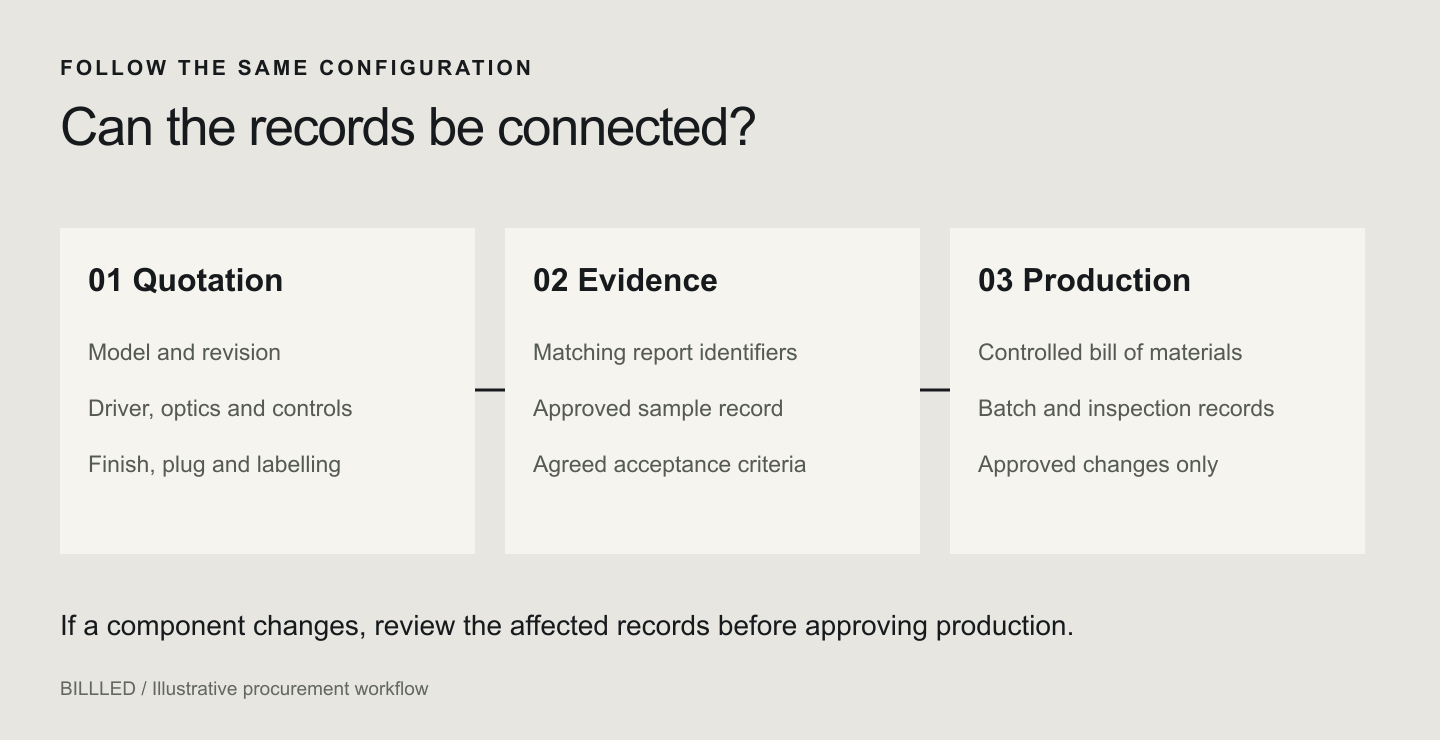
Driver substitutions, sensor changes, optical revisions and firmware settings can affect the product you approved. Ask which changes require your written agreement and which documents are reviewed when a change is proposed.
For an office floor lamp OEM project, establish a controlled specification and bill of materials at the appropriate level of detail. Tie the quotation, approved sample, drawings, labels and packaging to that revision. Confidential component details can be handled under an agreed information-sharing arrangement.
A revision history and a change request showing the reason, affected records and approval status.
What it verifiesChanges can be identified and reviewed before shipment. A new revision may require updated performance or compliance evidence.
QUESTION 06 / 07
Is the delivery plan specific to your order?
Separate sample preparation, custom development, production and transport. Ask when each timing estimate starts: after a deposit, component confirmation, artwork approval or sample sign-off. A single lead-time number can hide these dependencies.
Confirm the minimum order quantity, packaging scope, order quantity and shipping terms in the quotation. Then request a milestone plan that identifies long-lead components, approval deadlines, inspection and dispatch. Ask what would happen if a critical component were delayed.
An order-specific schedule, stated assumptions and a written process for reporting delays.
What it verifiesThe timing estimate is connected to real order requirements. General factory-capacity claims do not establish an available production slot.
QUESTION 07 / 07
Who owns technical communication and after-sales support?
During supplier evaluation, send one specific technical question and follow how it is handled. Does the response address the selected model? Does it identify missing information? Is there a named person who can coordinate an engineering answer?
Ask for warranty and service terms in writing, including coverage, exclusions, claim evidence, replacement arrangements and responsibility for shipping or other costs. Clarify spare-part availability and how discontinued components are handled. A warranty duration alone leaves many practical questions unanswered.
Named commercial and technical contacts, escalation steps and written service terms.
What it verifiesThere is an agreed route for resolving issues. It does not replace clear purchase and acceptance terms.
FROM ANSWERS TO A SHORTLIST
Make the next decision visible.
Keep the comparison simple. For each supplier, record the offered configuration, evidence received, open questions and the next approval milestone. Set mandatory conditions before comparing price: an unresolved requirement should remain visible even when the quotation is attractive.
| Record | What to capture |
|---|---|
| Configuration | Model, revision, target market and quoted options |
| Evidence status | Verified / pending clarification / not suitable, with document references |
| Open action | Missing record, responsible person and agreed response date |
| Next gate | Technical review, sample approval or production release |
A useful shortlist makes the unresolved work clear. It allows you to compare suppliers on a shared specification and decide what must be verified before the next commitment.
YOUR NEXT SUPPLIER CONVERSATION
Send a brief that invites a useful answer.
Include the target market, workspace, proposed quantity, product configuration, controls, branding scope, required documents and project dates. Ask which requirements can be confirmed now and which require further review.
For a BILLLED project, the Private Label & OEM/ODM overview is a starting point for discussing scope. Request configuration-specific documents and commercial terms for your project.
Discuss your projectBUYER QUESTIONS
Frequently asked questions
What should I check first when evaluating an office floor lamp supplier?
Identify the exact model and configuration that fit your project, then request the documents that support that configuration. Product fit, evidence and document traceability are more useful starting points than a general catalogue or an unsupported capacity claim.
Which documents should I request before approving a sample?
Request a configuration sheet, dimensional drawing, relevant performance evidence and a document list for the target market. Add a sample approval record and proposed acceptance criteria. The final package depends on the product, market and project.
Does a test report apply to every variant in a product family?
Do not assume that it does. Check the listed model, configuration and test conditions, and ask the supplier to explain variant coverage. Changes to components or controls may need a review of the affected evidence.
How should I compare delivery promises?
Compare schedules for the same order scope. Separate development, samples, production and transport, and state the approvals or component confirmations that start each stage. Request milestones and a process for communicating changes.
Sources & further reading
This checklist is general procurement guidance. Product and market requirements should be confirmed for the selected configuration.